This section pertains to setting up a business making and selling great numbers of papercrete blocks, and/or specializing in building large numbers of papercrete homes - at least more than one or two.
What we are working on is mainstreaming papercrete as an approved residential and commercial building material.
Our
One-Day Papercrete Commercialization Seminar offers strategies for starting
a business with BetR-blok, a new pressed type of papercrete.
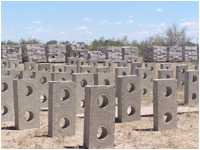 |
| Our BetR-blok system
produces strong, consistent blocks |
Presently, papercrete in all its forms is a victim of Catch-22. It's a question of market. Without a market, there's no investment. Without investment, it’s difficult to develop a market. Right now, it's a challenge to convince entrepreneurs to invest in block making operations when few people even know what papercrete is.
We are bringing about gradual change in the area of acceptance, but change takes time, and investors want a quick return on their investment. So, individuals interested in starting a papercrete business are probably going to have to
work in partnerships like the one we are suggesting or do it on their own
- at least for the time being.
The fact is that there are already markets for papercrete (especially for BetR-blok)
just not a mass market yet. So, to get started, an individual is going to have to
develop his or her own market - go out and get an order for some blocks and then
fill the order.
The largest potential market for blocks at this moment is as "in-fill" for
homes. Since papercrete is not formally approved as a "load bearing" building material, it cannot legally be used in most localities to support a roof. But as “in-fill," the papercrete walls are built between roof-supporting posts and filled in between them, hence "in-fill." The posts are connected to the foundation at the bottom and tied in to beams on top. The roofing system is built on top of the beams. This approach is commonly called “post and beam."
Post and beam design has worked to get many homes and other structures
"approved" around the country - especially in the West. Papercrete works
well in this application but the post and beam approach adds additional
un-needed cost and complication to construction. We are striving to get approval
using BetR-blok for "load bearing" applications - no posts. The only hurdle is
ICC approval, which costs money and takes time.
Of course, with some limitations, papercrete can be used to build garages,
sheds and other structures, which do not house people. Another market is garden
and perimeter walls, or other landscaping applications. We have made bowls and
planters which have stood the test of time and stood up well in outside
conditions so there are a lot of ways to make money working with papercrete. But
here we're talking about building homes.
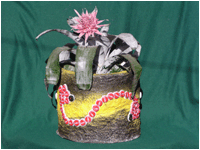 |
This is a papercrete
planter with bottle caps glued to it after painting with left over
spray paint. It's been out in the weather for a year with no visible
degradation. |
It 's possible to build nearly any type of home with BetR-blok if you can
find independent
engineers to "stamp" building plans. By approving the plans, the
engineers shift the liability from the local Building Safety office to their own
insurance company. Engineers are very dependent on their insurance companies.
They must have liability insurance in order to retain their license to do
business. If they make mistakes resulting in claims, their insurance company may well drop them. If one insurance
company drops them, they probably will not be picked up by another one. This means they will be out of business - their entire career down the
tubes. Engineering firms are especially loath to try anything new. Their
insurance payments are huge and their potential liability formidable. This
is the worse case scenario but it should be understood that it is sometimes
difficult to find engineers willing to take on the responsibility to try
something new. And if they do, they will probably want additional tests
performed to justify their assumptions and computations. We have worked with
engineers and generally they want some additional data before they agree to
stamps plans - they call it due diligence. As papercrete becomes more widely known and
tested, especially in a consistent form like BetR-blok, it will be less
difficult to find an engineer. Luckily, there are engineers out there - usually
individuals - who will work with papercrete builders. It just takes time to find
them. But let's get back to making blocks and building homes. What are the challenges? The first challenge is getting good information.
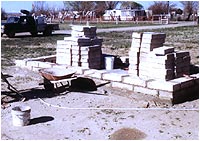 |
| Sheds under 120 square feet (12 square meters) usually do not require a permit. |
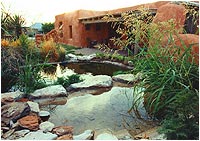 |
| A papercrete pond, which
has been holding water for three years, with no leaks. |
It makes obvious sense to verse oneself on the properties and characteristics of papercrete, whether
you want to sell blocks or build homes. The only way to do that is to read everything available on the Internet and contact others or read material from others who have already worked with the material. The frustrating thing about doing that is that previous builders have varying and sometimes conflicting recommendations about how to do things based on their experience. Most of the knowledgeable people working with papercrete have not had the time or opportunity to compare notes with other practitioners about what works and what doesn't. What each person feels is true is only true based on that person's experience. There are differences of opinion on just about everything - from the "best" mix to the "best" building method. For example, the construction approach described on this website specifies rebar in the construction of the walls.
Some practitioners feel that rebar is unnecessary. What is needed is a standard building procedure, which can be permitted anywhere in the country. Part of the problem with a standard building procedure is papercrete's flexibility. It can be poured, slip formed, formed as blocks, or as tilt-up panels, "harled,"
daubed, made into roof panels, etc. A comprehensive building procedure
describing all of these methods will eventually emerge but it hasn't yet. So the
best approach is to decide what product is to be marketed and then set about
defining the building approach which fits the product. That's what we are doing
with pressed BetR-blok. No one ever said it was
going to be easy, but we know what works. We've been actively involved in
papercrete construction for almost ten years. We can save people who want to
start a business a lot of time and money by passing on our business experience
and offering opportunities for partnerships. That's specifically what we
do in our
One-Day Papercrete Commercialization Seminar
So far, we and maybe a few other people are the only ones working on
equipment to produce papercrete in volume. This is true because most of the
people using papercrete are individuals busy building their own homes. Part of
the reason that volume papercrete mixers haven't been developed yet goes back to
the market for papercrete. Why invest in a developing a mixer for material which
isn't in widespread demand. The other reason is that the people using papercrete
are using it because it's cheap. Environmental and other benefits aside, they
are using it because they don't have a lot of money. So this group doesn’t have
the time or money to start engineering volume mixers. The lack of a low cost,
high volume mixer has been a barrier to producing papercrete in bulk.
Conventional concrete mixers cannot pulp newspaper or cardboard. But if the paper
or cardboard is hammer milled (pounded by spinning "hammers" into fiber),
a conventional small mixer will work fine. Even a large concrete truck can
be used to make the mix with hammer milled paper. But hammer milled paper cost a
lot and therein lies a problem. If the mix components become too
expensive, the profit margin on blocks is lowered to a point where it doesn't
make sense to make the blocks that any mixer is designed to produce. Another
approach is to use shredded paper. Shredded paper works in a conventional
concrete mixer. But it takes a lot longer (many more tank turns) to mix
papercrete components using shredded paper, because the shredded paper takes
longer to break down than hammer milled. So the optimum mixer - one
which pulps and mixes - does not exist off the shelf. That's where we come in.
We are perfecting a design for a volume mixer which pulps and mixes newspaper
and cardboard - and then elevates the mix for filling press hoppers or forms. We
have a Mega Mixer, which focuses on the least expensive way to
make and move mix. The secret to our approach was our press. Pressed blocks
are strong and consistent regardless of mix variations. That sounds counter
intuitive, but the press makes good blocks with the simplest mix recipe.
And simple, in this case - and in most others, is also the least expensive.
The next challenge to starting a business involves perceptions.
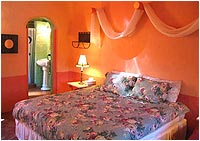 |
| Papercrete homes can be built beautifully, with all the amenities, for much less than conventional housing. |
Most people accept their initial perceptions as fact. "You only get one chance to make a first impression," as the old saying goes. This is as true of papercrete as anything else. If a person
goes to look at a home made of papercrete and the home is minimalist in appearance, that person will equate papercrete with minimalism. If a person sees a video about papercrete, and the presentation is amateurishly done, that person will conclude that papercrete is not to be taken seriously. Once the impression is made, it's difficult to change. But luckily, some artist-builders are
doing incredible design work with papercrete and are radically changing the early impressions of it. There will be a day in the not too distant future when papercrete will be
a material of choice for beauty, value, and durability.
A home built using innovative or "alternative" construction materials doesn't have to be uncomfortable to live in. In fact, many of these homes are more interesting to look at and more healthful and economical to live in than conventional housing - and they usually cost a lot less to build. Shrinking resources and expanding environmental concerns necessitate closer examination of alternative building techniques, which at first glance may seem untenable but turn out to offer dividends measured in many dimensions.
Papercrete, when made with Portland cement, looks a lot like concrete. This is a blessing and a curse. Many properties of papercrete make it more flexible than concrete, but in some ways it doesn’t act or perform the same as concrete. This leads some people to think that it isn't as "good" as concrete. The fact is that both materials have their strengths and weaknesses and both need to be used properly to be most effective.
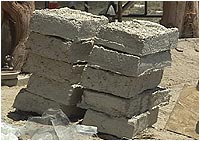 |
| Papercrete blocks are not always perfectly smooth or square, but it doesn’t matter. |
When I first saw a pile of papercrete blocks, I was struck by how rough and irregular they were and how much one block differed from another. This turns out to be completely natural. Inconsistencies in mix (see
Mixes), the type of paper used, the makeup of the paper, ambient temperature, humidity, hours of sunlight and other factors can cause changes in the final product. Papercrete is very forgiving but not completely consistent and, fortunately, it doesn't have to be.
Pressing is the solution. Pressed BetR-bloks are strong, straight and square,
and just more attractive than those poured on the ground.
As poured-on-the-ground papercrete blocks dry, they often slump or sag lengthwise and taper inward, from top to bottom, around their perimeter. This happens especially in a wet mix because there is less weight at the top of the mix when it is poured and more weight pushing out at the bottom. The result is a block that is not completely rectangular when viewed from the end, and may be bent slightly over its length. In addition, the surface of papercrete is often rough and the entire block may have quite a few small voids in it. At first, papercrete blocks seemed a little primitive to me compared to the perfect dimensions of concrete blocks and bricks. I quickly came to understand that I had to let "papercrete be papercrete." It's not concrete or brick or adobe. It's something different and the irregularities are actually not flaws but characteristics. In reality, the irregular shape is of no consequence and the rough surface and voids actually allow one block to adhere better to the next block when mortared together with a wet layer of papercrete.
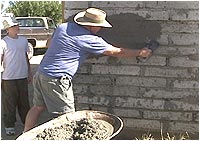 |
| Lex Terry applies papercrete stucco. No stucco wire is needed. |
When a wall of poured-on-the-ground papercrete blocks is completed, it will never be perfectly smooth - no matter how much care is taken in laying the block. It doesn't matter that it's not smooth. In fact, being rough helps the exterior stucco and interior finish to adhere to the wall. Areas that protrude too much can easily be trimmed with the claw side of a hammer. Areas that are too concave are simply built up with papercrete stucco. In the end, being careful with the outside stucco and the interior finish covers all seeming imperfections.
Walls made in tall forms, like those used in monolithic concrete pours, have their own unique characteristics. As explained under
Forms, trying to pour layers of great thickness results in a great deal of compression at the bottom of the form. This can cause the wall to dry very slowly and unevenly, and to shrink a great deal, resulting in pocketing that appears as voids and crevices. Usually these voids can easily be patched with a richer mix of papercrete and Portland cement or some other binder, which dries in the cracks and voids without shrinking.
Or the wet mix can be vibrated to allow air and water to come to the top of the
mix. Regardless of the "workaround", when the wall is covered outside and inside with stucco, or some other finish, the seeming imperfections are no longer visible. The final surfaces can be made as perfect as time and patience permit. So marketing should always be based on the final product, not on the process to get there.
Hydrophilic means having an affinity for water; readily absorbing water. Papercrete is hydrophilic. When I first learned that, I thought it was a fatal flaw and set about finding a way to make papercrete waterproof - in other words to make it "hydrophobic." There are ways to waterproof papercrete without affecting the positive properties of the material. But even without waterproofing, when papercrete absorbs water (if it was originally mixed with sufficient binder) it doesn't lose its shape. In other words, it doesn't turn into mush like un-stabilized adobe. When water goes into untreated papercrete, it quickly evaporates as soon as the rain (or other source of water) stops. Untreated papercrete is temporarily heavier while carrying the water, but as long as it can shed the water through evaporation (in other words as long as it can breathe) the water is not harmful. If the water is trapped and retained, mold, mildew, fungus, etc. may take hold. Trapping water in any building material is to be avoided. That's why it's best to either let the material breathe or moisture proof it completely. Many structures with untreated papercrete walls and roofs have been standing for years with no apparent ill effects, but
waterproofing papercrete is practical and possible.
It might not be a great idea to build in a flood plain with papercrete but plywood, drywall and other materials don’t do well in water either. Building in flood plains will probably be prohibited in the not-too-distant future, because insurance companies are trying to refuse issuing insurance to homes constructed in flood prone areas.
It would seem to make sense that papercrete would do best in dry climates of the world like the Great American Desert, which comprises a good deal of the western United States. However, there are homes made partly of paper in locations like Vancouver Island - off British Columbia, Wisconsin and even Rockport, Massachusetts. The Paper House in Rockport was built in 1924. It's in-filled with newspapers glued together and covered with varnish. Kelly Hart's home, in the mountains of Colorado, has been through over 200 freeze-thaw cycles since it was built and has exhibited no degradation or change in appearance. So humidity, water ,and snow may not be as great an issue as previously thought.
The term "flame retardant" has to be differentiated from "fireproof." Unless you add a significant percentage of non-flammable material to any papercrete mix, it will burn. It
will not burn with an open flame, but it will smoulder like charcoal
and eventually be consumed. Papercrete made with a 4-to-1 ratio of cement to
paper, by weight, won't burn at all, but that amount of cement is too
costly and may negatively affect R-value. Papercrete made with a 1-to-1 ratio of
cement to paper, by weight, will smolder like charcoal, but does not burn with
an open flame. Smoldering with no flame is considered flame retardant. So
might a fire smolder in a papercrete wall for for some time without detection?
The chances of this happening are extremely low.
A papercrete practitioner tested this possibility and thinks that such an occurrence is highly unlikely. He bored a three-inch hole in a papercrete wall and emptied an entire can of charcoal lighter fluid inside. He managed to get the papercrete to begin to smolder, but it would not continue to smolder for long because of lack of oxygen. It was suggested that fireproof mortar (high percentage of Portland cement or other fireproof binder) be used between the blocks as walls are erected, and fireproof stucco be used on the outside of the home to "encase" the blocks in fireproof "containers." This would limit a smoldering fire to the destruction of only one block in the unlikely event that it should ever occur at all.
In late 2005, we did some additional informal testing on papercrete and fire. A simple mix of boric acid and borax will completely firepoof papecrete. See the "Informal Tests" section in Tests. In early 2006, we have been doing experiments with sand content. Adding more sand increases compressive strength and fire retardancy,
but we don't know yet how much it effects "R" value, if any.
So there are significant challenges going into business making papercrete, but every beginning is difficult. One thing is certain. Papercrete is a concept whose time has come. Papercrete, in its present form, or something similar to it will have to be developed to stop the avalanche of our forests into our landfills. In any challenge there is also opportunity. The best future is for those who find the opportunities in the challenges and benefit themselves, others and the environment with their solutions.
This is our focus. |
